When you visit a website, you probably don’t think about how the images, videos, and text get to your screen so quickly. But behind the scenes, a complex network makes this magic happen – a Content Delivery Network (CDN).
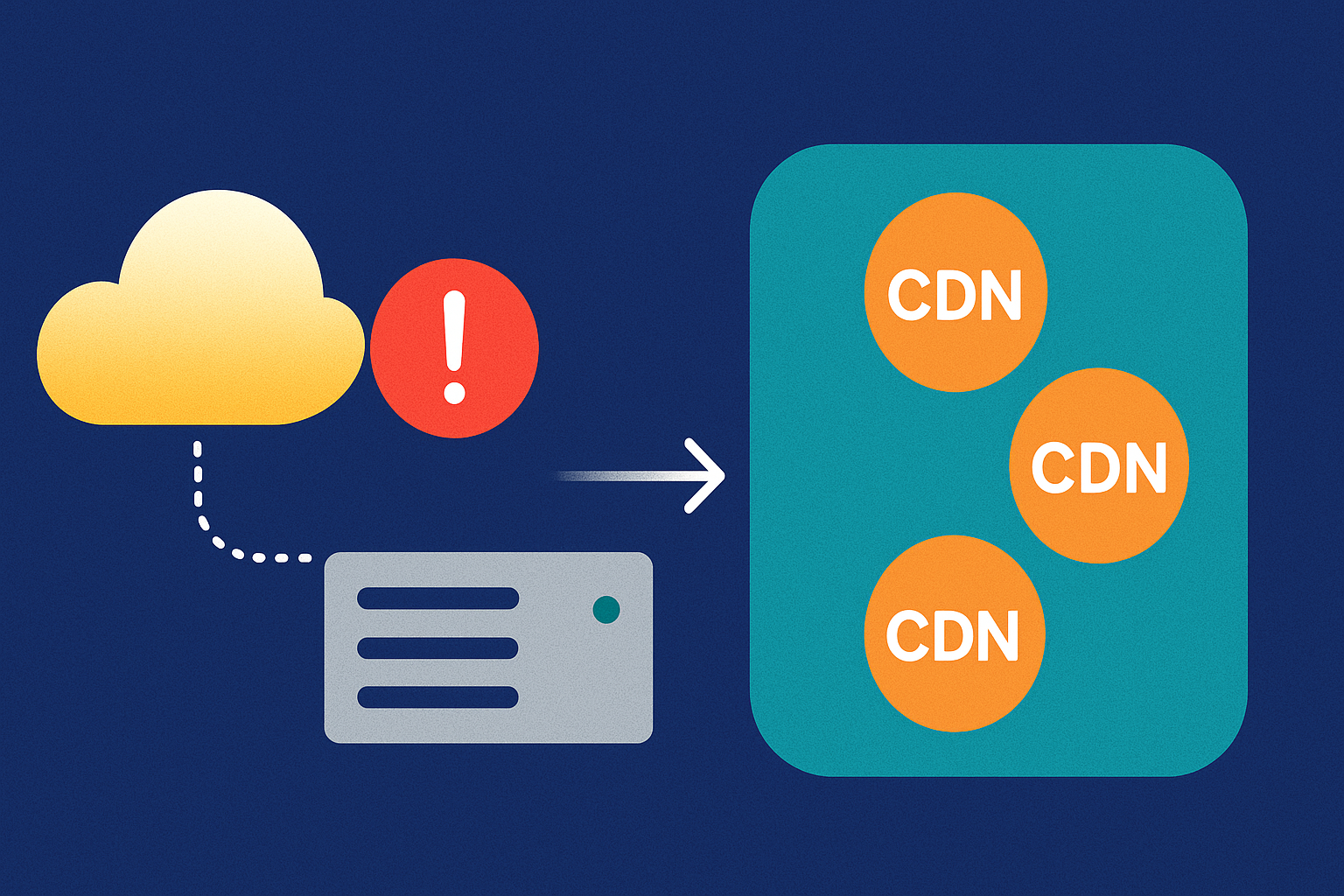
Recently, Cloudflare, one of the biggest players in this space, had some serious outages. When these happened, thousands of unrelated websites went down together. It wasn’t just one site having trouble – it was a massive ripple effect across the internet. So what happened? And more importantly, what can companies do to protect themselves from this kind of widespread disruption?
The tech world’s answer is simple: don’t put all your eggs in one basket. Instead of relying on just one CDN provider, companies are turning to multi-CDN architecture, similar to how companies have turned to microservices architecture for the backend and micro frontends as well.
In this article, we’ll explore how recent Cloudflare outages exposed the risks of single-CDN dependency, what multi-CDN architecture is, and how DNS makes it all work.
Why Recent Cloudflare Outages Exposed the Risk of Single-CDN Dependency
Think of a CDN like a delivery network for the internet. Just as packages travel through different hubs to reach your door, web content travels through CDN servers to reach your device. When you rely on just one delivery company and they have a bad day, all your packages stop moving. That’s exactly what happened when Cloudflare had its recent outages.
On November 18, 2025, Cloudflare experienced a major outage that lasted several hours. Popular websites like OpenAI, Twitter, and Spotify became inaccessible to millions of users worldwide. Then, just weeks later on December 5, another significant outage affected about 28% of Cloudflare’s HTTP traffic for 25 minutes. These weren’t small hiccups. They were massive disruptions that showed just how much the internet depends on a few key players.
The problem isn’t Cloudflare itself – they’re a great company with solid technology. The problem is putting all your trust in one provider. When DNS and CDN services are consolidated under one roof, the blast radius of any failure becomes enormous.
Different industries felt the impact differently:
- E-commerce sites saw sales drop to zero during the outage
- SaaS platforms couldn’t serve their customers
- Fintech applications had transactions halted
- Media streaming services experienced buffering and interruptions
This centralized approach creates a single point of failure that can bring down thousands of unrelated websites at once. It’s like if one traffic light controlled access to an entire city – when it breaks, everything stops. The lesson is clear: when a single CDN fails, thousands of unrelated websites go down together.
What Is Multi-CDN Architecture and Why It Solves This Problem
So what’s the alternative? Multi-CDN architecture. Think of multi-CDN like having multiple delivery partners instead of relying on just one. If Delhivery faces an outage, Blue Dart, DTDC, or India Post can still deliver your package. That’s the basic idea behind multi-CDN.
Multi-CDN architecture means using more than one CDN provider to deliver your content. Instead of sending all your traffic to one network, you spread it across multiple networks.
There are two main approaches:
- Active-Passive: One CDN does all the work while others wait as backup
- Active-Active: Multiple CDNs share the workload simultaneously
This is fundamentally different from traditional single-CDN setups where all your content flows through one provider.
Here’s an important point that often confuses people: Multi-CDN does NOT mean using multiple nameservers for one domain. That’s a different concept entirely. Multi-CDN is about having multiple content delivery networks working together, coordinated by intelligent routing.
The benefits are clear:
- If one CDN goes down, others keep working
- You can choose the best CDN for each user based on location and performance
- No vendor lock-in with one provider
- Better global coverage since each CDN has strengths in different regions
Compared to single CDN setups, multi-CDN provides redundancy, better performance, and peace of mind. It’s like having backup plans for your backup plans.
How DNS Enables Multi-CDN Failover and Traffic Steering
Now let’s talk about the secret sauce that makes multi-CDN work: DNS.
DNS (Domain Name System) acts as the control plane for multi-CDN architectures. Think of it as the air traffic controller directing planes to the best runway. When someone types your website address, DNS decides which CDN should handle their request.
This happens through several mechanisms:
- Latency-based routing: DNS checks which CDN can respond fastest for each user and sends them there.
- Health checks: DNS constantly monitors each CDN to see if they’re working properly. If one goes down, traffic automatically gets routed to the healthy ones.
- Geo-routing: Users get sent to the CDN closest to their location for the fastest experience.
The flow looks like this:
User → DNS → Best CDN → Origin ServerThis system also uses subdomain strategies. For example, you might send images to one CDN, videos to another, and static files to a third – all coordinated by DNS.
To really understand this, it helps to know how DNS works in general. The difference between authoritative DNS (which stores your domain records) and recursive DNS (which looks up those records) becomes important in multi-CDN setups.
DNS-based traffic routing gives companies fine-grained control over how their content reaches users. It’s not just about failover – it’s about optimizing every request for speed and reliability.
Why More Companies Will Adopt Multi-CDN After Cloudflare Outages
The recent Cloudflare outages were a wake-up call for many businesses. When your website going down means losing customers, sales, and reputation, reliability becomes more valuable than minor cost savings.
We’re seeing a shift in priorities:
- Reliability over cost: Companies realize that a few extra dollars spent on redundancy is worth it compared to the cost of an outage
- Regulatory compliance: Some industries now require uptime guarantees that single CDNs can’t provide
- Vendor lock-in concerns: Relying on one provider creates business risks that companies want to avoid
Enterprise patterns are emerging where companies use two or three CDNs strategically. They’re not just duplicating services – they’re combining the strengths of each provider. Some use one CDN for North America, another for Europe, and a third for Asia-Pacific regions. Others might use one for static content and another for dynamic content. The trend is clear: companies are designing more resilient systems by default, not as an afterthought.
Cloudflare outages didn’t break the internet – but they changed how companies design it.
Building a More Resilient Web
Multi-CDN architecture represents a fundamental shift toward more resilient web infrastructure. While single-CDN solutions worked well for years, recent events have shown the inherent risks of centralization.
By spreading traffic across multiple providers and using DNS for intelligent routing, companies can achieve:
- Higher availability (often 99.999% uptime)
- Better performance for global audiences
- Protection against vendor-specific issues
- More negotiating power with providers
The initial setup is more complex than a single CDN, but the benefits far outweigh the extra effort. As more companies adopt this approach, we’ll see a more distributed, resilient internet that’s less vulnerable to single points of failure.
Whether you’re running a small blog or a large enterprise platform, understanding multi-CDN architecture and DNS routing is becoming essential knowledge for anyone serious about web performance and reliability.