DNS Security Basics (DNSSEC, Spoofing, Poisoning)
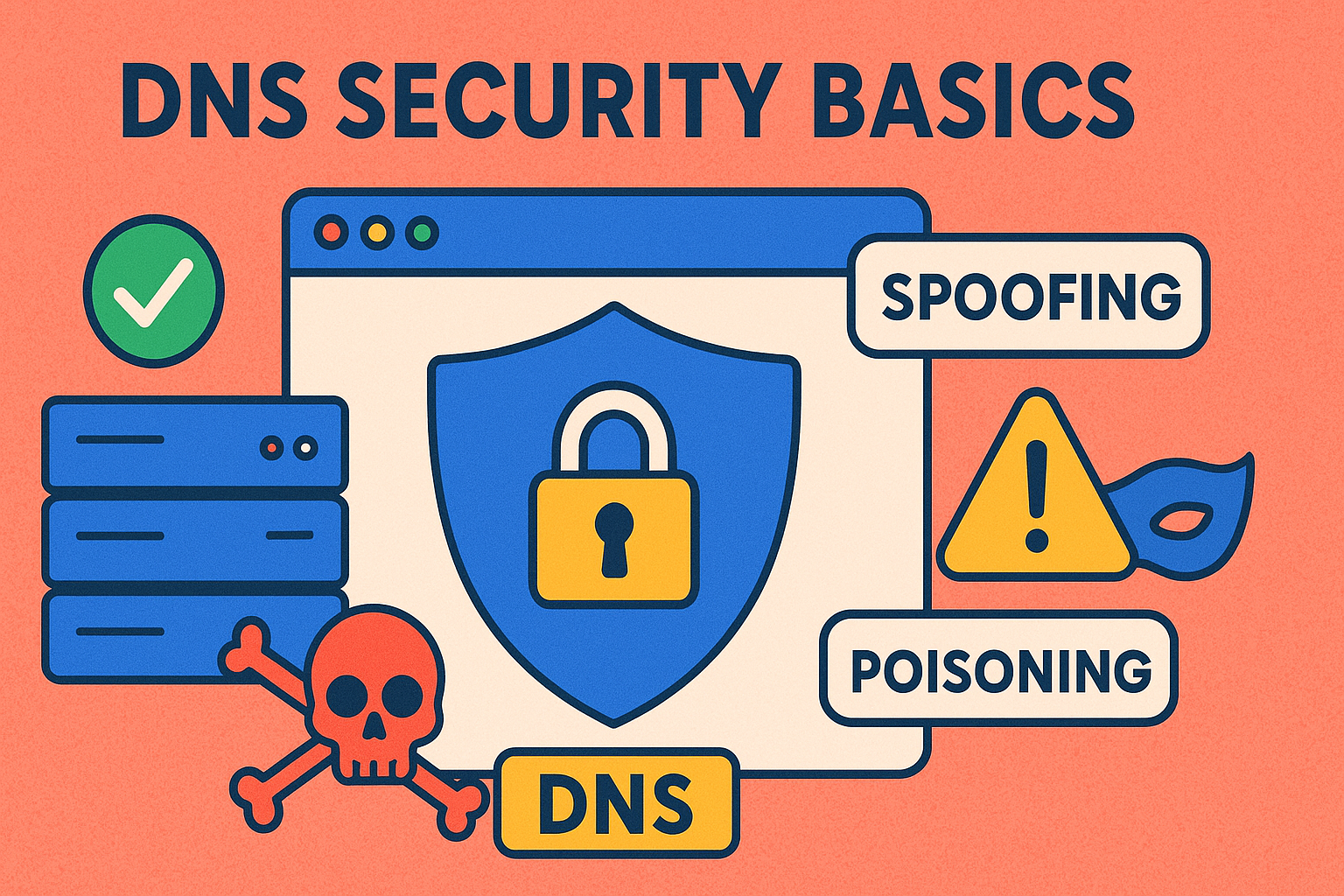
📋 Topic Synopsis
No excerpt available
DNS security is one of the most overlooked aspects of internet infrastructure, yet it's critically important. Every time you visit a website, send an email, or use any internet service, you're trusting DNS to guide you safely to the right destination. But what happens when that trust is broken?
In this topic on DNS server, we'll explore the most common DNS security threats and the tools available to protect against them. Even if you're not a security expert, understanding these basics can help you make safer choices online.
1. Comprehensive DNS Security Risks
Spoofing
DNS spoofing (also called DNS cache poisoning) occurs when attackers insert false information into DNS resolvers' caches. This redirects users to malicious websites without their knowledge.
For example, an attacker might poison a DNS cache so that when users try to visit their bank's website, they're actually directed to a fake site designed to steal login credentials.
How spoofing works:
- Attacker sends falsified DNS response to a resolver
- Resolver caches the false information
- Future queries for that domain return the malicious IP
- Users are unknowingly redirected to attacker's site
Types of DNS Spoofing
- Cache Poisoning: Injecting false records into resolver caches
- Response Spoofing: Sending fake responses to intercept queries
- Request Spoofing: Manipulating DNS queries before they reach resolvers
Impact of Spoofing
Consequences of successful DNS spoofing:
- Credential theft through phishing sites
- Malware distribution
- Financial fraud
- Data exfiltration
- Reputation damage to legitimate organizations
Cache Poisoning
Cache poisoning is a specific type of spoofing where attackers corrupt DNS cache data. It's particularly dangerous because once a cache is poisoned, all users of that resolver are affected until the false information expires.
Modern DNS implementations have protections against simple cache poisoning, but sophisticated attacks can still succeed.
Cache Poisoning Techniques
Advanced poisoning methods:
- Kaminsky Attack: Exploiting predictable transaction IDs
- Birthday Attacks: Statistical approach to guessing transaction IDs
- Fast Flux: Rapidly changing IP addresses to evade detection
- Ghost Domain: Registering expired domains to capture traffic
Detection and Prevention
Identifying cache poisoning attempts:
- Monitor for unusual DNS response patterns
- Check for unexpected TTL values
- Watch for sudden changes in popular domain resolutions
- Implement DNS monitoring solutions
MITM Attacks (Man-in-the-Middle)
In DNS-based MITM attacks, attackers intercept and modify DNS queries and responses between users and DNS servers. This allows them to redirect traffic or monitor communications.
Unlike spoofing, which targets DNS resolvers, MITM attacks typically target individual connections.
DNS MITM Attack Vectors
Common interception methods:
- Network-level interception: Compromising network infrastructure
- WiFi attacks: Rogue access points or compromised networks
- Malware: DNS-changing malware on endpoint devices
- Proxy manipulation: Controlling web proxies or firewalls
Advanced MITM Techniques
Sophisticated attack approaches:
- SSL Stripping: Downgrading encrypted connections
- Certificate Forgery: Creating fake SSL certificates
- DNS Tunneling: Using DNS for covert data transmission
- Protocol Manipulation: Exploiting DNS protocol weaknesses
2. In-Depth Introduction to DNSSEC
Digital Signatures
DNSSEC (DNS Security Extensions) adds a layer of security to DNS by digitally signing DNS records. These signatures prove that DNS data comes from the authoritative source and hasn't been tampered with.
Think of DNSSEC signatures like wax seals on important documents - they prove the document is authentic and hasn't been altered.
How DNSSEC Works
DNSSEC implementation involves:
- Cryptographic Keys: Generating public/private key pairs
- Digital Signatures: Signing DNS records with private keys
- Signature Validation: Verifying signatures with public keys
- Chain of Trust: Establishing trust from root to domain
DNSSEC Record Types
Key DNSSEC record types:
- RRSIG: Resource Record Signature
- DNSKEY: DNS Public Key
- DS: Delegation Signer
- NSEC/NSEC3: Next Secure Record (proves non-existence)
- CDNSKEY/CDNSKEY: Child DNSKEY for automated key rollover
Chain of Trust
DNSSEC works through a chain of trust:
- Root zone is signed
- Top-level domains (.com, .org, etc.) are signed
- Individual domain zones are signed
- Each level validates the signatures of the level below it
If any link in this chain is broken or compromised, DNSSEC-aware resolvers will reject the DNS data.
Trust Anchor Management
Establishing trust anchors:
- Root Zone Key: The foundation of DNSSEC trust
- KSK Rollover: Regular key rotation for security
- Algorithm Agility: Supporting multiple cryptographic algorithms
- Backup Keys: Maintaining key recovery procedures
DNSSEC Validation Process
End-to-end validation workflow:
- Resolver requests DNS record
- Server returns record with RRSIG
- Resolver fetches DNSKEY from parent zone
- Validates signature using public key
- Proceeds if validation succeeds, blocks if fails
3. Comprehensive DNSSEC Implementation
Signing Zones
To implement DNSSEC for your domain:
- Generate keys:
# Generate Zone Signing Key (ZSK)
dnssec-keygen -a RSASHA256 -b 2048 -n ZONE example.com

# Generate Key Signing Key (KSK)
dnssec-keygen -a RSASHA256 -b 2048 -n ZONE -f KSK example.com

# Modern algorithm recommendation
dnssec-keygen -a ECDSAP256SHA256 -n ZONE example.com- Sign your zone:
dnssec-signzone -A -o example.com -k Kexample.com.+008+12345 db.example.com- Update your zone file with DNSSEC records
Key Management Best Practices
Secure key handling procedures:
- Separate Keys: Use different keys for signing and key signing
- Regular Rotation: Rotate ZSK frequently, KSK less often
- Secure Storage: Protect private keys with appropriate access controls
- Backup Procedures: Maintain secure backups of all keys
DS Records
DS (Delegation Signer) records link your signed zone to the parent zone. You must provide your DS record to your domain registrar, who will add it to the parent zone's DNS records.
The DS record contains:
- Key tag
- Algorithm
- Digest type
- Digest of your public key
DS Record Submission Process
Steps for DS record registration:
- Generate DS record from your DNSKEY
- Submit to domain registrar
- Verify publication in parent zone
- Monitor for proper delegation
DS Record Management
Advanced DS record handling:
- Automated Rollovers: Using CDS/CDNSKEY for key updates
- Multiple Algorithms: Supporting algorithm transitions
- Monitoring Tools: Tracking DS record publication status
DNSSEC Validation Configuration
Enabling DNSSEC validation:
# BIND configuration
options {
    dnssec-validation auto;
    dnssec-enable yes;
};

# Unbound configuration
server:
    auto-trust-anchor-file: "/var/lib/unbound/root.key"
    val-clean-additional: yes
4. Advanced Security Best Practices
Disabling Recursion
Unless you specifically need to provide recursive DNS service to other users, disable recursion on your authoritative DNS servers:
options {
    recursion no;
    allow-recursion { none; };
    additional-from-auth no;
    additional-from-cache no;
};
This prevents attackers from using your server in amplification attacks.
Recursion Security Controls
Granular recursion management:
- Access Control Lists: Limit recursion to trusted networks
- Rate Limiting: Control query volume from recursive clients
- Query Validation: Filter suspicious recursive queries
- Logging: Monitor recursive query patterns
Rate Limiting
Implement rate limiting to prevent DNS-based DDoS attacks:
options {
    rate-limit {
        responses-per-second 5;
        window 10;
        slip 2;
        ipv4-prefix-length 24;
        ipv6-prefix-length 56;
    };
};
Advanced Rate Limiting
Sophisticated rate limiting strategies:
- Slip Ratios: Drop packets without response to reduce amplification
- Prefix-Based Limits: Apply limits per network subnet
- Response Rate Limiting: Control authoritative server responses
- Adaptive Thresholds: Dynamically adjust limits based on traffic
Logging & Monitoring
Enable detailed logging to detect suspicious activity:
logging {
    channel security_log {
        file "/var/log/named/security.log" versions 3 size 100m;
        severity info;
        print-time yes;
        print-category yes;
        print-severity yes;
    };
    category security { security_log; };
    category client { security_log; };
    category network { security_log; };
};
Monitor logs regularly for:
- Unusual query volumes
- Suspicious domain lookups
- Failed DNSSEC validations
- Unexpected server access
- Pattern-based anomalies
Security Information and Event Management (SIEM)
Integrating DNS logs with SIEM systems:
- Centralized Logging: Aggregate DNS data from multiple servers
- Correlation Rules: Link DNS events with other security data
- Automated Alerts: Notify of suspicious activities
- Incident Response: Facilitate rapid threat investigation
Access Control and Authentication
Implement strong access controls:
# BIND access control
acl trusted {
    192.168.1.0/24;
    localhost;
};

options {
    allow-query { trusted; };
    allow-transfer { trusted; };
    allow-update { none; };
};
Advanced Access Controls
Enhanced security measures:
- TSIG Keys: Cryptographically secure zone transfers
- Dynamic Updates: Controlled record modification
- View-Based Access: Different responses for different clients
- Response Policy Zones: DNS-level content filtering
5. Real-World Attack Examples and Case Studies
Kaminsky Attack
In 2008, researcher Dan Kaminsky discovered a fundamental flaw in DNS that allowed widespread cache poisoning. The vulnerability existed because DNS transaction IDs were predictable, making it possible for attackers to successfully guess them and inject false records.
This led to emergency patches across the entire internet infrastructure and highlighted the need for DNSSEC adoption.
Technical Details
The Kaminsky vulnerability exploited:
- Transaction ID Prediction: 16-bit ID space was too small
- Query Prediction: Predictable query characteristics
- Timing Attacks: Statistical approaches to guessing
Industry Response
Coordinated response efforts:
- Embargo Period: Coordinated disclosure timeline
- Simultaneous Patches: Vendor coordination for fixes
- DNSSEC Acceleration: Increased adoption incentives
- Protocol Improvements: Enhanced randomness in implementations
Mirai Botnet DNS Amplification
The Mirai botnet used DNS amplification attacks to generate massive DDoS attacks. By sending small queries to open DNS resolvers with spoofed source IPs, attackers could generate responses hundreds of times larger than the original queries.
These attacks could overwhelm targets with traffic while hiding the true source of the attack.
Attack Mechanics
DNS amplification process:
- Botnet Compromise: Infect IoT devices
- Open Resolver Discovery: Find vulnerable DNS servers
- Spoofed Queries: Send queries with victim's IP as source
- Amplified Responses: Large responses flood victim
- Traffic Multiplication: Massive bandwidth multiplication
Mitigation Strategies
Defense approaches:
- Recursion Controls: Disable open recursion
- Rate Limiting: Implement response rate limiting
- Source Validation: Deploy anti-spoofing measures
- Traffic Filtering: Block amplification attack patterns
BGP Hijacking Combined with DNS
Some sophisticated attacks combine BGP (Border Gateway Protocol) hijacking with DNS manipulation. By rerouting internet traffic and then poisoning DNS caches, attackers can intercept communications on a massive scale while making detection more difficult.
Attack Vector
Combined attack methodology:
- BGP Hijack: Redirect internet traffic paths
- DNS Interception: Capture and manipulate DNS queries
- Cache Poisoning: Inject false DNS records
- Data Harvesting: Collect sensitive information
- Traffic Restoration: Remove BGP hijack to hide tracks
Defense in Depth
Multi-layer protection strategies:
- RPKI: Resource Public Key Infrastructure for BGP security
- DNS Monitoring: Detect anomalous resolution patterns
- Route Validation: Verify BGP announcement legitimacy
- Network Segmentation: Limit attack surface exposure
6. Emerging DNS Security Threats
DNS-over-HTTPS (DoH) and Privacy Concerns
Privacy-enhancing DNS protocols introduce new considerations:
- Centralization Risks: Concentration of DNS queries to few providers
- Enterprise Visibility: Loss of network monitoring capabilities
- Malware Evasion: Bypassing traditional security controls
- Compliance Challenges: Regulatory monitoring requirements
IoT and DNS Security
Internet of Things devices present unique challenges:
- Limited Security: Weak device-level protections
- Default Configurations: Vulnerable default DNS settings
- Botnet Recruitment: Easy targets for compromise
- Network Impact: Large-scale coordinated attacks
Cloud and Container Security
Modern deployment architectures affect DNS security:
- Dynamic Environments: Rapidly changing DNS requirements
- Microservices: Complex service discovery needs
- Container Isolation: DNS resolution in containerized environments
- Zero Trust: DNS-based identity and access controls
7. Summary & Key Takeaways
DNS security is essential for maintaining trust in internet infrastructure. Here are the essential points to remember:
- Threat Landscape: DNS faces diverse attack vectors from spoofing to advanced persistent threats
- DNSSEC Foundation: Cryptographic validation provides strong protection against many attacks
- Implementation Complexity: Proper DNSSEC deployment requires careful planning and expertise
- Operational Security: Access controls, monitoring, and rate limiting are critical defenses
- Emerging Challenges: New protocols and architectures introduce evolving security considerations
- Defense in Depth: Multiple layers of protection provide comprehensive security
- Continuous Vigilance: Ongoing monitoring and adaptation are essential for security
While implementing DNSSEC requires technical expertise, understanding the risks and basic protective measures can help anyone make better decisions about their online security. As DNS attacks become more sophisticated, staying informed about these threats is increasingly important for everyone who relies on the internet.
Whether you're managing enterprise infrastructure or simply using the internet, DNS security affects everyone. By understanding these concepts and implementing appropriate protections, you can help make the internet a safer place for all users.